

You already know the feeling. A project that seemed crystal clear in the first conversation turns into a mess of revision requests, scope additions, and frustrated emails three weeks in. The culprit is almost always the same: nobody properly documented client requirements before starting work. In project management, this process is formally called requirements elicitation and documentation, and it is one of the most underused skills in a freelancer's toolkit. Get it right, and you avoid scope creep, protect your time, and deliver work your clients actually wanted.
Table of Contents
- Key takeaways
- What you need before you document client requirements before starting
- Step-by-step process to gather and document requirements
- Common mistakes that derail requirement documentation
- How to verify and finalize requirements before work begins
- My honest take on documenting requirements as a freelancer
- Keep your requirements organized with Qoviro
- FAQ
Key takeaways
| Point | Details |
|---|---|
| Prepare before you document | Identify decision-makers and gather existing materials before your first formal session. |
| Elicit, don't just collect | Use structured questions and kickoff meetings to draw out real needs, not just surface requests. |
| Assign IDs and acceptance criteria | Every requirement needs a unique identifier and a clear pass/fail test to prevent disputes later. |
| Get written approval before work starts | A signed or confirmed requirements document creates a baseline that protects both parties. |
| Keep internal and client docs separate | Your working notes with assumptions belong in a different file than the client-facing summary. |
What you need before you document client requirements before starting
Before you open a blank document and start typing, you need a few things in place. Skipping this preparation step is why so many freelancers end up with incomplete or contradictory requirements that cause problems later.
Identify who actually makes decisions. Not every person on a client call has approval authority. Confirming who has approval authority early prevents bottlenecks where you complete work only to hear "let me check with my manager." Ask directly: "Who has final sign-off on deliverables?" Write that name down.
Clarify what success looks like. This sounds obvious, but most clients describe outputs, not outcomes. "We need a new website" is an output. "We need to increase demo requests by 30% in 90 days" is an outcome. Push for the outcome, because that is what you will be measured against.
Gather everything that already exists. Ask for previous project files, brand guidelines, competitor examples they like or dislike, and any past vendor work. Clients often have more documentation than they realize. This material saves you from asking questions that have already been answered.
Here is a quick requirements checklist for clients to work through before your first formal session:
- Names and contact details of all key stakeholders
- Final decision-maker confirmed in writing
- Project goals stated as measurable outcomes
- Existing documentation, brand assets, and reference materials
- Budget range and hard deadline (if any)
- Known constraints or non-negotiables
Pro Tip: Design your intake forms so they are hard to submit incorrectly. Required fields, dropdown options, and character limits improve first-pass completeness and cut down the back-and-forth before work even begins.
For tools, a simple Google Form or Typeform works for intake. A shared Google Doc or Notion page works for the living requirements document. The specific tool matters less than having a consistent, repeatable process.
Step-by-step process to gather and document requirements
This is where most freelancers either skip steps or improvise. A repeatable process protects you on every project, regardless of size.
-
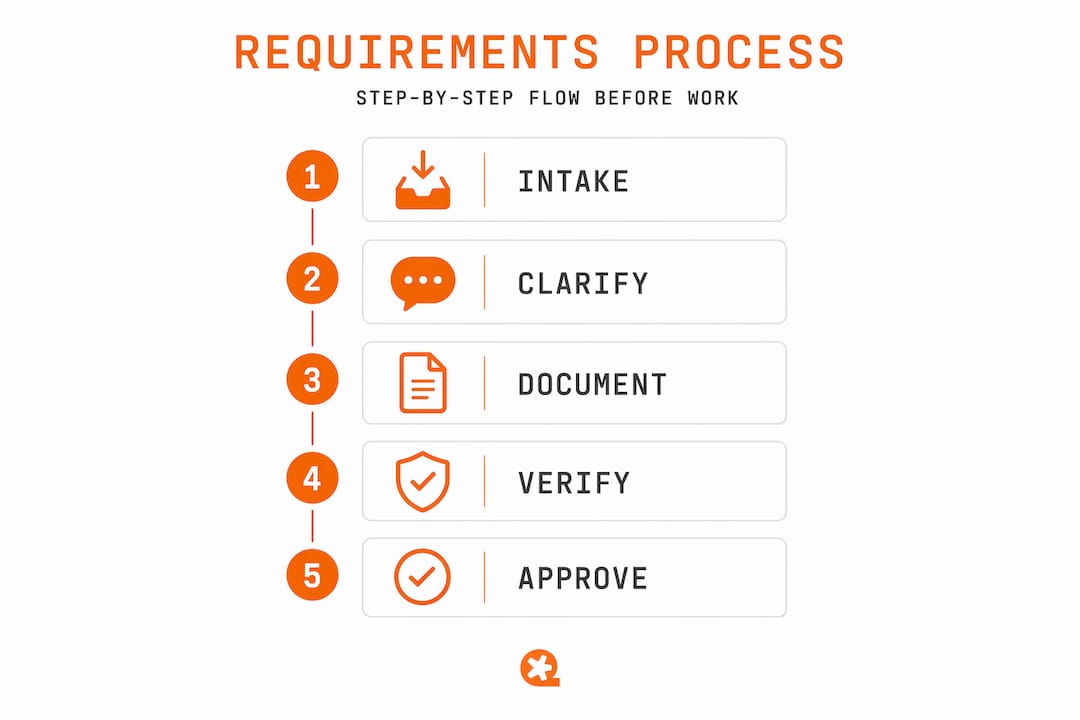
Send an intake form before the kickoff call. The form captures basic project context so your kickoff meeting can focus on decisions, not data collection. Ask about goals, timeline, budget, and known constraints. Sending intake forms before kickoff then using the meeting for decision-making is the workflow that minimizes churn.
-
Run a structured kickoff meeting. Cover five things: how success is defined, what the non-negotiables are, who communicates with whom and how often, what risks exist, and what happens if scope changes. A written one-page recap sent within 24 hours after the kickoff prevents misunderstanding better than any contract clause.
-
Document requirements with unique IDs. Every requirement gets a reference number (REQ-001, REQ-002, and so on), a plain-language description, a priority level, and acceptance criteria. Acceptance criteria and unique IDs create a baseline that reduces disputes and scope creep. "The homepage loads in under 2 seconds on mobile" is an acceptance criterion. "The homepage should be fast" is not.
-
Prioritize using the MoSCoW method. A project requirements document that lists everything as equally important is useless. MoSCoW sorts requirements into Must Have, Should Have, Could Have, and Won't Have. This forces honest conversations about what is truly critical versus what would be nice.
-
Build a requirements traceability matrix. This is a simple table that links each requirement to its source, its priority, its current status, and how it will be verified. A traceability matrix typically includes columns for requirement ID, description, source, priority, status, and verification method. It sounds formal, but even a basic spreadsheet version protects you when a client says "that was never part of the plan."
-
Get written confirmation before starting any work. Freelancers should not start work before a signed agreement and initial payment are in place. The same principle applies to requirements: no work begins until the documented requirements are approved in writing.
| Method | Best for | Limitation |
|---|---|---|
| Intake form | Capturing baseline project info | Misses nuance and follow-up questions |
| Kickoff meeting | Decisions, alignment, and priorities | Easy to forget without a written recap |
| MoSCoW prioritization | Ranking requirements by importance | Requires honest client participation |
| Traceability matrix | Tracking changes and approvals | Adds overhead on very small projects |
Pro Tip: When you record requirements, write them from the client's perspective using the format "The system/deliverable shall [action] so that [business reason]." This keeps requirements testable and ties every item back to a real need.
Common mistakes that derail requirement documentation
Even freelancers who know they should define project requirements often fall into predictable traps. Here is what actually goes wrong, and how to avoid it.
Collecting instead of eliciting. There is a meaningful difference. Collecting is passive: you ask "what do you need?" and write down whatever the client says. Eliciting is active: you ask follow-up questions, challenge vague answers, and draw out requirements the client has not articulated yet. Requirements are elicited through structured engagement, not just gathered like a grocery list. A client who says "I want it to look modern" needs you to ask: "Can you show me three examples of sites you consider modern?"
Ignoring stakeholder disagreements. When two people on the client side give you conflicting answers, the temptation is to move on and hope it resolves itself. It never does. Surface the disagreement in writing and ask the decision-maker to resolve it before you proceed.
Skipping formal approval. Many freelancers share a requirements summary and assume silence means agreement. It does not. You need an explicit confirmation, either a reply email saying "approved" or a signature on the document.
The single most expensive mistake a freelancer can make is starting work based on a verbal agreement. A written, approved requirements document is not bureaucracy. It is the only record that protects your time and your invoice when a client changes their mind.
Mixing internal notes with client-facing documents. Your working file might include assumptions, open questions, and gaps you have not resolved yet. That document should never go to the client. Maintain separate internal documents with assumptions and gaps, and keep client-facing summaries limited to confirmed, agreed requirements.
Using unclear communication channels. If requirements are discussed across email, Slack, text messages, and phone calls, nothing is traceable. Pick one channel for formal requirement decisions and document every change there.

How to verify and finalize requirements before work begins
Documenting requirements is only half the job. The other half is making sure everyone agrees with what you wrote down. This is the pre-project client review phase, and most freelancers rush it.
-
Schedule a dedicated review session. Do not just email the document and ask for feedback. Walk through it together, section by section. This is where clients catch things they forgot to mention, and where you catch things you misunderstood.
-
Resolve every open item before approval. If your document has placeholders or items marked "TBD," those need answers before you lock the baseline. A business requirements document that still contains unknowns is not ready to be approved.
-
Get a formal confirmation. An email reply that says "looks good, approved" is sufficient. A digital signature is better. The point is to create a clear record that the client reviewed and accepted the documented requirements.
-
Establish a change request process. Once requirements are baselined, any addition or change goes through a formal request. Define this upfront: who can submit a change, how you will assess the impact on timeline and cost, and how long you have to respond.
-
Send a kickoff summary that recaps all agreements. This single-page document covers the approved scope, key milestones, communication cadence, and who is responsible for what. It is not a contract. It is a shared reference point that both sides can return to when questions arise.
Pro Tip: Number every version of your requirements document (v1.0, v1.1, v2.0) and note what changed between versions. When a client later claims the scope was always different, version history is your clearest evidence.
My honest take on documenting requirements as a freelancer
I have seen freelancers treat requirements documentation as a bureaucratic hurdle they tolerate before the "real work" begins. That framing is backwards. In my experience, the documentation process is the work. It is where you discover whether a client actually knows what they want, whether the budget matches the ambition, and whether you are the right fit for the project.
The most common misconception I see is that thorough documentation slows things down. It does not. The projects that move fastest are the ones where requirements were locked down before a single deliverable was produced. Rework is what slows you down, and rework almost always traces back to a requirement that was assumed rather than confirmed.
What I have learned is that clients respect the process when you frame it correctly. You are not asking them to fill out paperwork. You are protecting their investment and making sure the project succeeds. That framing changes the conversation entirely.
The other thing I will say: do not confuse detail with client-friendliness. A 40-page requirements specification will overwhelm most clients and get skimmed. A clear, well-organized two-page summary with numbered requirements and a simple approval step gets read and signed. Match the depth of your documentation to the complexity of the project, not to your anxiety about scope creep.
— Lilian
Keep your requirements organized with Qoviro
Getting your client requirement documentation right is only as effective as the system you use to manage it. If your intake forms live in one app, your client messages in another, and your approval confirmations buried in email threads, something will fall through the cracks.
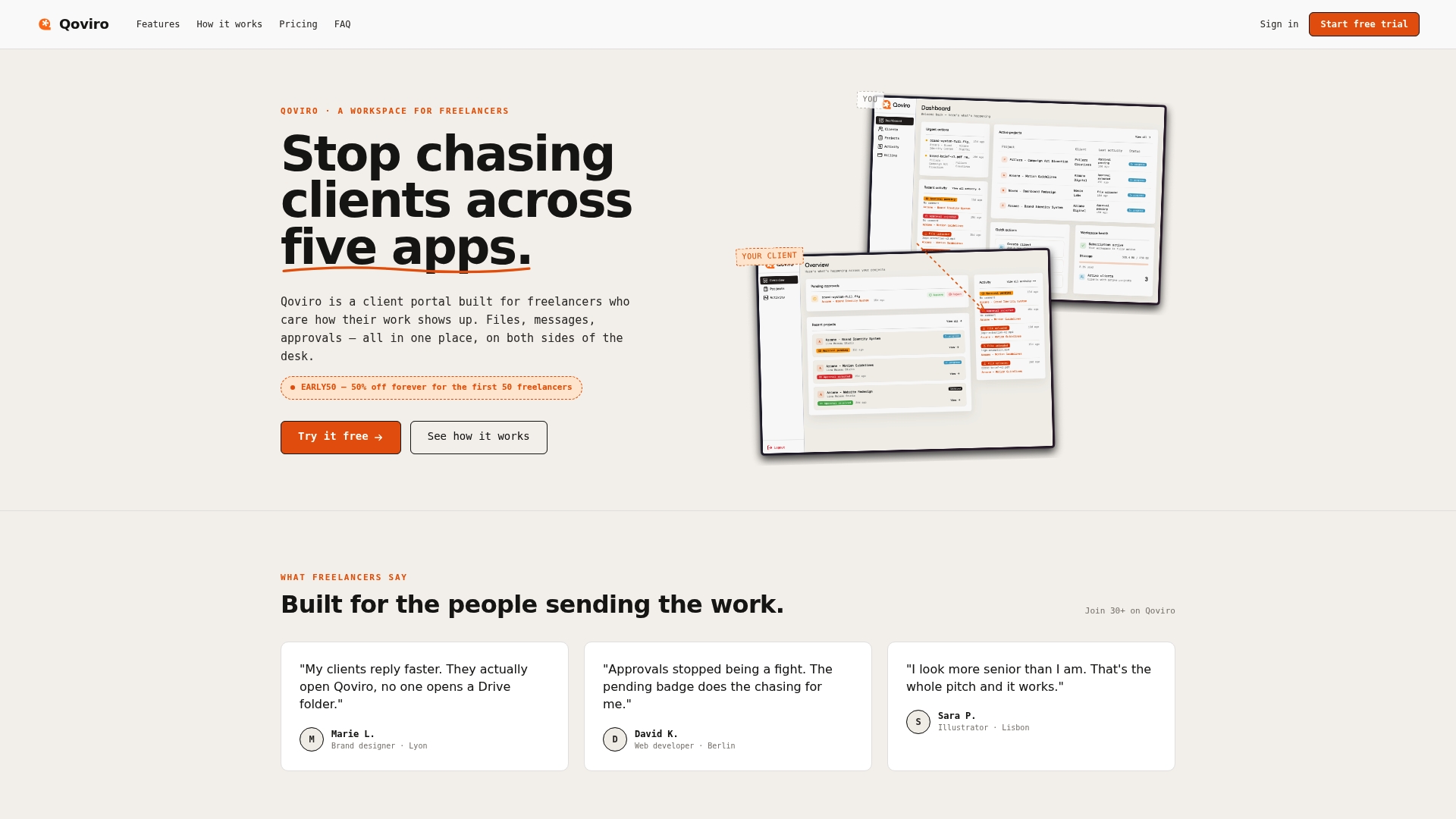
Qoviro brings intake, communication, files, and approvals into one project-organized interface built specifically for freelancers. Instead of chasing clients across five different tools, you send a structured intake form, run your kickoff, share the requirements document for review, and collect approval, all in one place. Clients get a clean, professional experience. You get a clear record of every decision. The result is fewer delays, fewer misunderstandings, and projects that actually start on solid ground. If you are serious about capturing client expectations before work begins, Qoviro gives you the structure to do it without the overhead.
FAQ
What does it mean to document client requirements?
Documenting client requirements means recording every agreed project goal, deliverable, constraint, and acceptance criterion in a written format before work begins. It creates a shared reference point that both the freelancer and client can return to throughout the project.
How do I gather client needs effectively?
Send a structured intake form before your kickoff meeting, then use the meeting to clarify decisions and resolve ambiguities. Follow up with a written summary within 24 hours to confirm what was agreed.
What should a requirements checklist for clients include?
A solid checklist covers the project goal stated as a measurable outcome, the final decision-maker, known constraints, timeline, budget range, and any non-negotiables the client has identified upfront.
What is the MoSCoW method in requirements documentation?
MoSCoW sorts requirements into Must Have, Should Have, Could Have, and Won't Have categories. It forces clients to prioritize honestly and prevents every feature from being treated as equally critical.
When should requirements be approved before starting work?
Requirements should be formally approved in writing before any billable work begins. A signed document or explicit email confirmation creates a baseline that protects both parties if scope disputes arise later.