

Most professionals assume that doing excellent work is enough to keep clients happy. It rarely is. A professional client experience is not just about the quality of your deliverables. It is about how clients feel at every point in their relationship with you, from the moment they first hear your name to the follow-up after a project closes. That distinction matters more than most freelancers and small business owners realize, and understanding it is the first step toward building a practice that generates referrals, repeat business, and genuine loyalty.
Table of Contents
- Key takeaways
- What is a professional client experience in practice
- Core elements that shape client perception
- Measuring client experience the right way
- How to improve client experience in professional services
- My take on where most professionals get this wrong
- How Qoviro helps you deliver a polished client experience
- FAQ
Key takeaways
| Point | Details |
|---|---|
| Experience vs. service | Client service is what you do; client experience is what clients feel across every interaction. |
| The full journey matters | Perceptions form at every stage, especially before onboarding and after project close. |
| Measure multiple dimensions | Use NPS, CSAT, and CES together to get an accurate picture of client sentiment. |
| Edge moments drive churn | Neglecting the start and end of a client relationship can undo strong mid-project delivery. |
| Systems beat good intentions | Consistent, professional experience requires structured processes, not just a friendly attitude. |
What is a professional client experience in practice
The industry term for this concept is client experience management (CXM), and it describes the deliberate design and improvement of how clients perceive every interaction with your business. A professional client experience covers the entire relationship lifecycle, not just the phase where you are actively doing the work.
One useful way to map that lifecycle is the 5Es framework: Entice, Enter, Engage, Exit, Extend. Each stage represents a distinct set of client perceptions.
- Entice: How clients discover you and form initial impressions through your website, referrals, or social proof.
- Enter: The onboarding process, including contracts, intake forms, and first communications.
- Engage: Active project delivery, where most professionals focus the majority of their attention.
- Exit: Project close, final deliverables, and the handoff experience.
- Extend: Post-project follow-up, referrals, and whether clients return.
The critical insight here is that most professionals pour their energy into the Engage stage and neglect the rest. That is a costly mistake.
Client service vs. client experience
These two terms are often used interchangeably, but they describe fundamentally different things.
| Dimension | Client service | Client experience |
|---|---|---|
| Definition | What you do for the client | What the client feels throughout the relationship |
| Scope | Specific interactions or requests | Entire lifecycle from first contact to post-project |
| Measurement | Task completion, response time | Perception, trust, ease, and emotional tone |
| Owner | The person delivering the work | Every touchpoint across your business |
Customer service is a component within customer experience. CX encompasses all interactions and perceptions, not just support or delivery. A client can receive technically excellent work and still feel undervalued if the onboarding was confusing, the billing was opaque, or the project close felt abrupt. Excellent service can still leave clients feeling undervalued when the edges of the journey are neglected.
Core elements that shape client perception
Once you understand that client experience spans the full relationship, the next question is: what actually drives it? The answer comes down to four qualities that clients assess, often unconsciously, at every touchpoint.
Consistency is the foundation. Clients need to know what to expect from you. When your communication style, response times, and document quality vary from project to project, it creates low-level anxiety that erodes trust over time.

Ease is underrated. Clients should not have to work hard to do business with you. If they need to chase you for status updates, dig through email threads to find a file, or figure out your approval process on their own, the friction accumulates. Client experience management requires empathy and structured feedback, not just reactive service fulfillment.
Transparency builds confidence. Clients who can see where a project stands, what decisions are pending, and what comes next feel in control. That feeling of control is a direct driver of satisfaction.
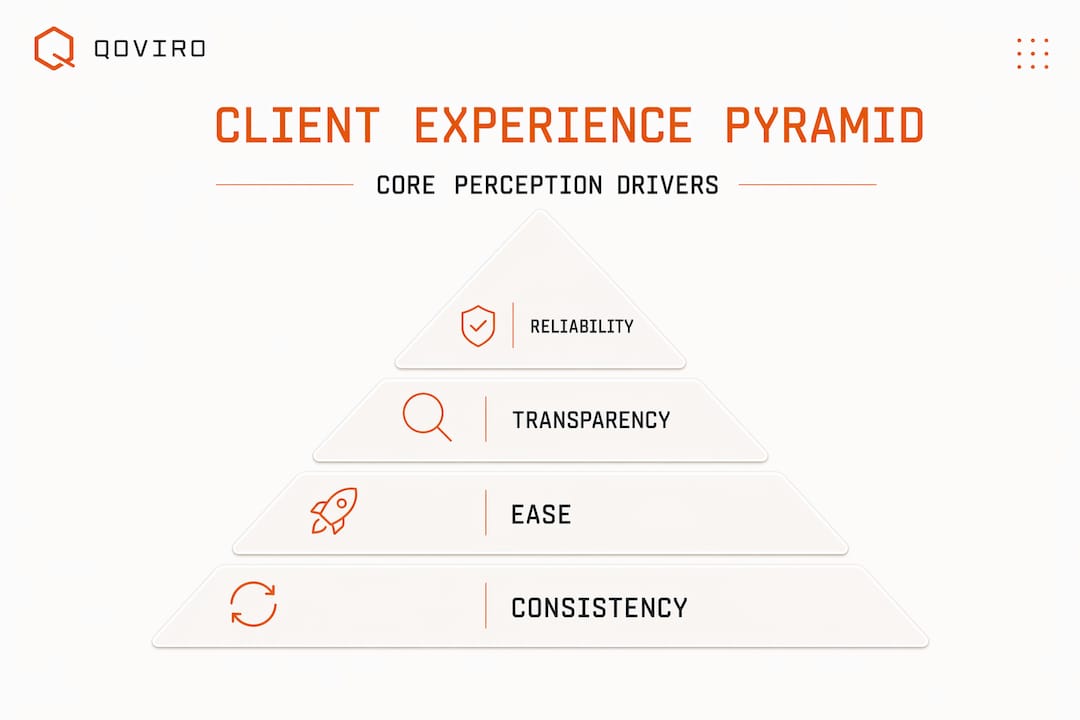
Reliability closes the loop. Showing up when you say you will, delivering what you promised, and following up without being asked signals professionalism at a level that pure technical skill cannot replicate.
These elements extend well beyond the work itself. They show up in how you handle onboarding, how you structure your billing, and how you close a project. Good experience reduces friction and builds trust, which drives organic growth and expansion through referrals and repeat engagements.
Pro Tip: Map every client touchpoint outside of the actual project work. Onboarding emails, invoice formats, approval requests, and project close messages are all experience moments. Review each one and ask: does this feel clear, professional, and easy for the client?
Measuring client experience the right way
You cannot improve what you do not measure. The challenge is that most professionals either skip measurement entirely or rely on a single satisfaction score that tells an incomplete story.
The three most useful metrics in professional services are:
| Metric | What it measures | When to use it |
|---|---|---|
| NPS (Net Promoter Score) | Loyalty and likelihood to refer | After project close or at renewal |
| CSAT (Customer Satisfaction Score) | Satisfaction with a specific interaction | After onboarding, key milestones, or delivery |
| CES (Customer Effort Score) | How easy it was to work with you | After approval processes or billing interactions |
NPS measures loyalty, CSAT measures satisfaction, and CES measures effort, and each captures a different dimension of the experience. Using only one of them is like diagnosing a health problem by checking only your temperature. You might catch something obvious, but you will miss a lot.
Timing matters as much as the metric itself. Sending a satisfaction survey three weeks after a project closes produces vague, low-quality responses. Sending a short CES check immediately after a client completes an approval process captures a specific, actionable data point. Combining quantitative, qualitative, and behavioral data prevents misleading conclusions that a single metric would produce.
Qualitative feedback is equally valuable. A follow-up call or a two-question open-ended survey can surface issues that no score would reveal. The goal is a closed-loop system: you collect feedback, you act on it, and you let the client know what changed. That last step is what most professionals skip, and it is the one that builds the most trust.
Pro Tip: Tie every survey to a specific journey moment, not just the end of a project. Ask about onboarding within 48 hours of kickoff, ask about ease of approvals right after a revision cycle, and ask about overall experience at project close. Context makes the data usable.
How to improve client experience in professional services
Knowing the framework is one thing. Putting it into practice is another. Here is a practical sequence for improving client experience without overhauling your entire business at once.
-
Audit your journey edges first. Before you change anything in your delivery process, look at what happens before onboarding and after project close. Clients form strong perceptions at journey edges, and these are the moments most professionals ignore. A weak onboarding experience can undermine everything that follows.
-
Standardize your document workflows. Contracts, briefs, approval requests, and invoices are not just administrative tasks. They are experience touchpoints. High-trust client experiences reduce delays by standardizing processes from intake to signature. When a client receives a clean, well-structured brief or a clear approval request, it signals competence before a single deliverable is reviewed.
-
Design for visibility, not just delivery. Clients who cannot see project status have to ask for it. Every time they ask, you are creating friction. Build status updates and progress visibility into your process so clients always know where things stand without having to chase you.
-
Treat client experience as a system, not a personality trait. Client experience is a systems issue involving process and coordination, not just a matter of being friendly or responsive. Structured collaboration and visible control are direct experience levers. This means written processes, consistent templates, and defined communication cadences, not just good intentions.
-
Close projects deliberately. Most professionals end projects by delivering the final file and going quiet. A deliberate project close, including a summary of what was accomplished, a clear handoff, and a prompt asking for feedback, turns an afterthought into a loyalty-building moment. It is also the best time to ask for a referral.
-
Act on feedback visibly. When a client tells you something was confusing or slow, fix it and tell them you fixed it. This single practice does more for client retention than almost any other improvement.
My take on where most professionals get this wrong
I have spent years watching talented professionals lose clients they should have kept. The work was good. The results were real. But the experience around the work was an afterthought, and clients eventually drifted to someone who made them feel more organized, more informed, and more valued.
The most common mistake I see is treating client experience as a personality question. "I am friendly and responsive, so my clients are happy." That may be true during the project. But what happened during onboarding? What did the client feel when they had to email you three times to get a file? How did the project close feel?
Poor client experience results in churn even when technical work is strong. I have seen this play out repeatedly. A freelancer with exceptional skills loses a long-term client to someone with average skills but a polished, organized process. The client did not leave because the work got worse. They left because the experience felt unprofessional.
The other mistake is relying on a single satisfaction score. An NPS of 8 feels reassuring until you realize three clients gave you a 10 and two gave you a 4, and you never asked why. Mature measurement pairs multiple metrics contextually to surface the real picture. A single number flattens complexity you need to understand.
My honest advice: stop asking whether your clients are satisfied and start asking whether your process would impress a skeptical new client on day one. If the answer is no, that is where you start.
— Lilian
How Qoviro helps you deliver a polished client experience
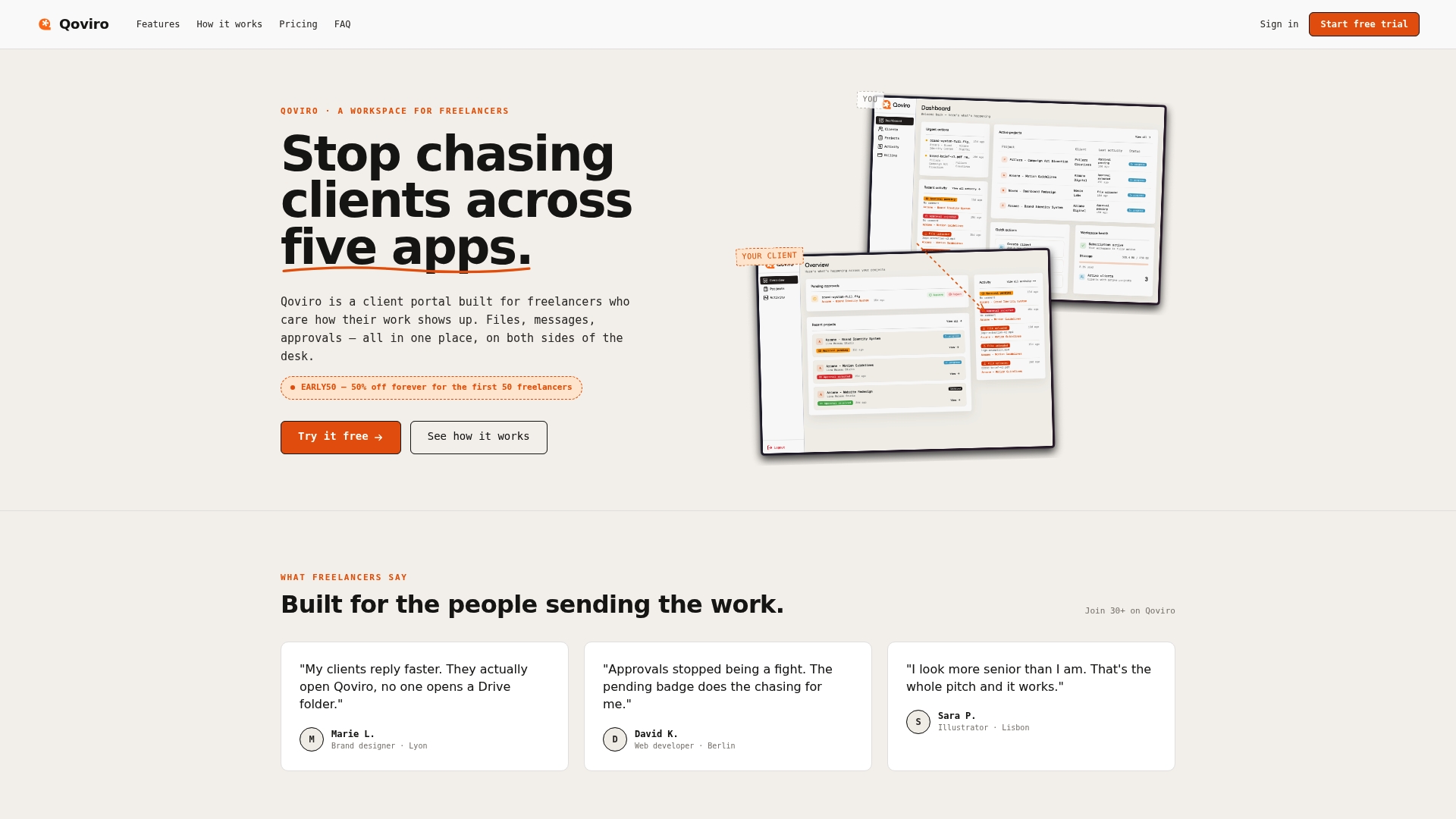
If the frameworks in this article resonated but the implementation feels overwhelming, that is exactly the problem Qoviro was built to solve. Qoviro is a client portal designed for freelancers and small studios that brings files, approvals, and messages into one organized space, sorted by project. Instead of chasing clients across email threads, shared drives, and chat apps, you give them a single place to review work, leave feedback, and sign off. That kind of organized, visible process is what separates a professional client experience from a chaotic one. Clients respond faster, approvals move quicker, and your work looks as polished as it actually is.
FAQ
What is the difference between client service and client experience?
Client service refers to specific interactions where you help a client, while client experience covers how the client feels across every touchpoint in the entire relationship, from first contact through post-project follow-up.
Why do clients leave even when the work is good?
Poor client experience drives churn even when technical quality is high. Clients often leave because onboarding was confusing, communication was inconsistent, or the overall process felt disorganized, not because the deliverables were weak.
What metrics should I use to measure client experience?
Use NPS to measure loyalty, CSAT to measure satisfaction at specific touchpoints, and CES to measure how easy it was to work with you. Combining all three metrics gives a far more accurate picture than any single score.
What are the most important stages of the client journey to improve?
The edges matter most. The period before onboarding and the project close phase are where perceptions form and where most professionals invest the least attention. Improving these two stages often produces the fastest gains in client retention.
How do I start improving my client experience without a big overhaul?
Start by auditing every touchpoint outside of your actual project work: onboarding emails, approval requests, invoices, and project close messages. Standardize these first, then build in feedback collection at key journey moments to identify where friction exists.